| Date |
Politics |
Censorship |
Publishing |
Culture |
Selected decisions |
| 1910 |
Union of South Africa created out of the nineteenth-century Boer republics (Orange Free State and Transvaal) and British territories (Cape and Natal) |
|
|
Official languages are Dutch and English |
|
| 1912 |
South African Native National Congress (precursor to the African National Congress) formed |
|
|
New African movement gains momentum |
|
| 1913 |
|
Customs Management Act |
|
|
|
| 1914 |
National Party formed |
|
|
|
|
| 1915 |
|
|
Nasionale Pers founded |
Hertzog Prize founded |
|
| 1916 |
|
|
Die Huisgenoot founded |
|
|
| 1918 |
Afrikaner Broederbond formed |
|
|
|
|
| 1921 |
South African Communist Party formed |
|
|
International PEN founded in Britain |
|
| 1922 |
Inkatha founded |
|
|
|
|
| 1925 |
|
|
|
Afrikaans replaces Dutch as second official language in the Union |
|
| 1927 |
|
|
|
SA PEN founded |
|
| 1930 |
|
|
|
Négritude movement launched in Paris |
|
| 1931 |
|
Entertainments (Censorship) Act establishes the first Board of Censors |
|
|
|
| 1932 |
|
|
Afrikaanse Pers founded (later APB) |
|
|
| 1934 |
United Party and Purified National Party formed |
Censorship Board’s powers extended to imported books |
|
Afrikaans Writers’ Circle founded |
|
| 1935 |
|
|
Bantu Treasury Series launched |
Afrikaans Coalition for the Free Book launched |
|
| 1937 |
|
|
|
|
Cloete’s Turning Wheels banned |
| 1939 |
|
|
|
Van Wyk Louw coins the phrase lojale verset (‘loyal resistance’) |
|
| 1942 |
|
|
Fighting Talk founded |
|
|
| 1943 |
|
|
African Bookman Series launched |
|
|
| 1945 |
|
|
Standpunte launched; mission presses still dominate African-language publishing |
Afrikaner historians affirm their own cultural history in narrowly nationalist terms |
|
| 1947 |
|
|
Traditional Markets Agreement ensures that British publishers continue to dominate English-language publishing in South Africa until the 1970s |
|
|
| 1948 |
D. F. Malan’s National Party comes to power on a platform of apartheid |
|
|
|
|
| 1949 |
Prohibition of Mixed Marriages Act |
|
|
|
|
| 1950 |
Suppression of Communism Act, Population Registration Act, Group Areas Act, Immorality Amendment Act; SACP banned |
Press Enquiry launched |
|
|
|
| 1951 |
|
|
Drum founded; Tydskrif vir Letterkunde, journal of the Afrikaans Writers’ Circle, launched |
|
|
| 1952 |
ANC-led nationwide Defiance Campaign |
|
|
|
|
| 1953 |
Non-Racial Liberal Party and Congress of Democrats formed; Bantu Education Act; SACP reconstituted underground |
|
|
|
|
| 1954 |
|
Cronjé inquiry into ‘Undesirable Publications’ launched |
New Age founded |
|
|
| 1955 |
Congress of the People adopts the Freedom Charter |
A new Customs Act consolidates previous measures to control imported books |
|
|
|
| 1956 |
Treason Trial begins |
|
Africa South founded; Purple Renoster launched |
Butler calls on English-language writers to affirm their own national tradition |
Bloom’s Transvaal Episode banned |
| 1957 |
|
Cronjé Report published |
|
|
Abrahams’s Tell Freedom banned |
| 1958 |
H. F. Verwoerd becomes Prime Minister |
|
Seven Seas founded in East Berlin |
|
Gordimer’s World of Strangers (hardback) and Paton’s Too Late the Phalarope (paperback) passed; Hofmeyer’s The Skin Is Deep and Stein’s Second-Class Taxi banned |
| 1959 |
Pan Africanist Congress (PAC) formed after a split within the ANC, partly over SACP links |
|
Human & Rousseau founded; African Communist launched |
|
Mphahlele’s Down Second Avenue passed |
| 1960 |
Sharpeville atrocities; ANC and PAC banned; Alex La Guma and Brian Bunting detained |
|
Contrast founded |
|
Hutchinson’s Road to Ghana banned |
| 1961 |
South Africa becomes a Republic; Treason Trial ends in acquittal; ANC adopts armed struggle |
|
|
Central News Agency Award founded; Mphahlele becomes head of the Congress of Cultural Freedom’s Africa programme; exile-led international cultural boycott gains momentum in Britain |
Matshikiza’s Chocolates for my Wife banned |
| 1962 |
General Law Amendment Act (Sabotage Act); Bunting and La Guma under house arrest |
Blanket bans affect individual writers, including La Guma, Pieterse, and Brutus |
Heinemann African Writers Series founded; New African launched; South Africa: Information and Analysis started |
|
Mphahlele’s African Image, Gordimer’s World of Strangers (paperback), Rooke’s Greyling, and La Guma’s Walk in the Night banned |
| 1963 |
Rivonia Trial (the well-known trial of Mandela) begins; foundation of the Christian Institute; First, Brutus, and La Guma detained |
New Publications and Entertainments Act covers imported and locally produced book; Dekker Board formed |
Classic founded; Sestiger launched |
Sestiger group emerges |
Modisane’s Blame me on History and Rive’s African Songs banned |
| 1964 |
Eight Rivonia accused, including Mandela, imprisoned for life; Hugh Lewin, a member of the African Resistance Movement, and Brutus imprisoned |
|
|
|
Rive’s Emergency and Smith’s Lion Feeds banned; one issue of Purple Renoster banned; Brink’s Lobola and Mutwa’s Indaba passed |
| 1965 |
|
Trial of Smith’s When the Lion Feeds |
|
|
La Guma’s Threefold Cord and Abrahams’s Wreath for Udomo banned; Leroux’s Sewe Dae passed |
| 1966 |
Verwoerd assassinated; B. J. Vorster becomes Prime Minister; Bram Fischer sentenced to life imprisonment |
Blanket bans affect individual writers, including Kunene, Matshikiza, Modisane, Mphahlele, and Nkosi, all by then in exile |
|
|
Gordimer’s Late Bourgeois World banned; Leroux’s Derde Oog passed |
| 1967 |
|
|
|
|
Nkosi’s Home and Exile and Jail Diary of Albie Sachs banned |
| 1968 |
Liberal Party dissolved; South African Students’ Organization (SASO) formed |
Kruger Board formed |
Kol launched; Buren founded |
Rise of Black Consciousness; Sestigers divided over lojale verset; UN General Assembly endorses the cultural boycott |
Brink’s Miskien Nooit passed |
| 1969 |
Bureau of State Security created; Serote imprisoned |
|
|
|
Cope’s Dawn Comes Twice banned |
| 1970 |
UN General Assembly declares apartheid ‘a crime against the conscience and dignity of mankind’ |
|
|
|
La Guma’s Stone Country banned |
| 1971 |
Ahmed Timol murdered in prison |
|
David Philip founded; Renoster Books launched |
|
|
| 1972 |
Black People’s Convention (BPC) formed |
|
Ravan Press founded; Black Review launched |
Music, Drama, Arts, and Literature Institute founded |
|
| 1973 |
Widespread strikes by black workers; rise of independent trade unions |
Kruger Commission launched; Biko, Strinivasa Moodley, and other members of SASO banned |
Ad Donker founded |
Black Literature and Arts Congress founded |
Serote’s Yakhal’inkomo passed; La Guma’s Fog of the Season’s End and Matthews’s Cry Rage! banned |
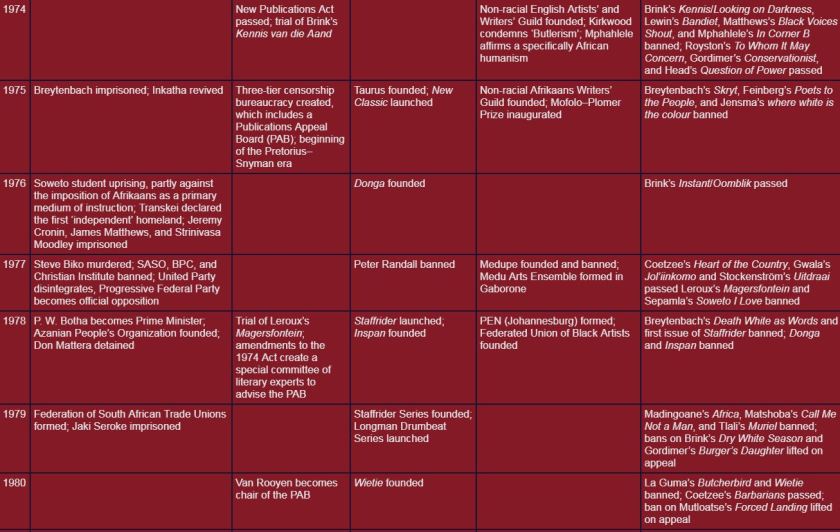
| 1974 |
|
New Publications Act passed; trial of Brink’s Kennis van die Aand |
|
Non-racial English Artists’ and Writers’ Guild founded; Kirkwood condemns ‘Butlerism’; Mphahlele affirms a specifically African humanism |
Brink’s Kennis/Looking on Darkness, Lewin’s Bandiet, Matthews’s Black Voices Shout, and Mphahlele’s In Corner B banned; Royston’s To Whom It May Concern, Gordimer’s Conservationist, and Head’s Question of Power passed |
| 1975 |
Breytenbach imprisoned; Inkatha revived |
Three-tier censorship bureaucracy created, which includes a Publications Appeal Board (PAB); beginning of the Pretorius–Snyman era |
Taurus founded; New Classic launched |
Non-racial Afrikaans Writers’ Guild founded; Mofolo–Plomer Prize inaugurated |
Breytenbach’s Skryt, Feinberg’s Poets to the People, and Jensma’s where white is the colour banned |
| 1976 |
Soweto student uprising, partly against the imposition of Afrikaans as a primary medium of instruction; Transkei declared the first ‘independent’ homeland; Jeremy Cronin, James Matthews, and Strinivasa Moodley imprisoned |
|
Donga founded |
|
Brink’s Instant/Oomblik passed |
| 1977 |
Steve Biko murdered; SASO, BPC, and Christian Institute banned; United Party disintegrates, Progressive Federal Party becomes official opposition |
|
Peter Randall banned |
Medupe founded and banned; Medu Arts Ensemble formed in Gaborone |
Coetzee’s Heart of the Country, Gwala’s Jol’iinkomo and Stockenström’s Uitdraai passed Leroux’s Magersfontein and Sepamla’s Soweto I Love banned |
| 1978 |
P. W. Botha becomes Prime Minister; Azanian People’s Organization founded; Don Mattera detained |
Trial of Leroux’s Magersfontein; amendments to the 1974 Act create a special committee of literary experts to advise the PAB |
Staffrider launched; Inspan founded |
PEN (Johannesburg) formed; Federated Union of Black Artists founded |
Breytenbach’s Death White as Words and first issue of Staffrider banned; Donga and Inspan banned |
| 1979 |
Federation of South African Trade Unions formed; Jaki Seroke imprisoned |
|
Staffrider Series founded; Longman Drumbeat Series launched |
|
Madingoane’s Africa, Matshoba’s Call Me Not a Man, and Tlali’s Muriel banned; bans on Brink’s Dry White Season and Gordimer’s Burger’s Daughter lifted on appeal |
| 1980 |
|
Van Rooyen becomes chair of the PAB |
Wietie founded |
|
La Guma’s Butcherbird and Wietie banned; Coetzee’s Barbarians passed; ban on Mutloatse’s Forced Landing lifted on appeal |
| 1981 |
|
Abraham Coetzee becomes chief censor; beginning of the Coetzee–van Rooyen era |
|
PEN (Johannesburg) disbanded; African Writers Association (AWA) founded; international cultural boycott re-energized with UN backing |
Mzamane’s Mzala passed; Sepamla’s Ride on the Whirlwind and Tlali’s Amandla banned |
| 1982 |
Internal Security Act; ANC opens its first cultural desk in London |
|
Skotaville founded; David Philip’s Africasouth Series launched, reprints many previously banned titles; The Classic revived |
AWA founds the H. I. E. and R. R. R. Dhlomo Drama Award, the Sol Plaatje Prose Award, and the S. E. K. Mqhayi Poetry Award; Culture and Resistance conference held in Gaborone |
Serote’s To Every Birth passed; Mzamane’s Children of Soweto banned; ban on the first issue of The Classic lifted on appeal |
| 1983 |
United Democratic Front (UDF) formed, establishes its own cultural desk |
|
|
Launch of the People’s Culture movement |
Serote’s Night Keeps Winking banned; Coetzee’s Life & Times passed |
| 1984 |
New tricameral Parliament created, giving limited rights to ‘Coloureds’ and ‘Indians’; P. W. Botha becomes first executive State President |
|
|
|
Freedom Charter unbanned |
| 1985 |
Congress of South African Trade Unions (COSATU) formed, establishes its own cultural desk; first in a series of States of Emergency declared |
|
|
Military raid on Gaborone kills members of Medu and the group disbands; Writers’ Forum founded |
|
| 1987 |
Seroke detained; COSATU headquarters bombed; Mbuli heads up the Transvaal Interim Cultural Desk, aligned to the UDF, Congress of South African Writers, and COSATU; right-wing Conservative Party becomes official opposition |
|
Ravan firebombed |
COSAW founded; Culture in Another South Africa Festival in Amsterdam |
|
| 1988 |
UDF premises destroyed; UDF and COSATU restricted along with other organizations; Mbuli detained; government attempts to cut off foreign donor support |
|
|
COSAW founds the Alex La Guma/Bessie Head Fiction Award |
Rushdie’s Satanic Verses banned; Ndebele’s Fools passed |
| 1989 |
F. W. de Klerk becomes State President |
|
|
Progressive writers hold discussions about cultural matters with the ANC in Zimbabwe |
|
| 1990 |
Nelson Mandela released; ANC, PAC, SACP unbanned |
Van Rooyen not reappointed as chair of the PAB |
|
Sachs’s paper ‘Preparing Ourselves for Freedom’ provokes extensive debate |
|
| 1994 |
First democratic elections held; Nelson Mandela becomes President |
|
|
|
|
| 1995 |
Constitutional Court inaugurated; Truth and Reconciliation Commission established |
|
|
|
|
| 1996 |
Democratic constitution signed into law |
New Publications Act passed, abolishing the censorship system |
|
New South Africa has eleven official languages |
|